
Sleep Recovery Research
5 Signs Your Body Isn't Fully Shutting Down at Night
(Even If You Sleep 7–8 Hours)
Waking up tired. Brain fog that lasts until noon. Low energy all day. Poor recovery no matter what you try. If this sounds familiar, your nervous system may be working against you—even while you sleep.

You go to bed at a reasonable hour.
You get your 7–8 hours. You do everything you're "supposed" to do.
And yet... you still wake up exhausted.
It's not just tiredness—it's that heavy, foggy feeling that makes you wonder: "Why does it feel like I didn't sleep at all?"
What if the problem isn't how long you sleep—but how deeply your body actually recovers?

Many people sleep enough hours but still wake up feeling unrested
The truth is, sleep quantity and sleep quality are two very different things.
You can spend 8 hours in bed and still miss out on the deep, restorative sleep your body desperately needs to repair, recover, and recharge.
Why Your Body Isn't Truly Resting (Even When You're Asleep)
Here's what most people don't realize: your nervous system has two modes—and you need both to function properly.
There's the "fight or flight" mode (sympathetic nervous system) that keeps you alert, focused, and ready to respond to stress.
And there's the "rest and digest" mode (parasympathetic nervous system) that allows your body to calm down, repair itself, and achieve deep sleep.
The problem? Modern life keeps many of us stuck in "alert mode"—even when we're trying to sleep.
Chronic stress, screen time, caffeine, and constant mental stimulation train your nervous system to stay activated. Even when you close your eyes, your body may never fully switch into recovery mode.
This means you're technically "sleeping"—but your body isn't doing the deep restoration work it needs to do.
"Magnesium plays a key role in the regulation of sleep... Magnesium deficiency has been associated with heightened stress and anxiety, both of which can negatively impact sleep quality."
— Journal of Research in Medical Sciences
The Missing Mineral Your Nervous System Needs
Think of magnesium as the brake pedal for your nervous system.
While stress hormones act like a gas pedal—keeping you revved up and alert—magnesium helps your body slow down, relax, and shift into recovery mode.

Deep, restorative sleep requires your nervous system to fully relax
Magnesium helps regulate GABA—the neurotransmitter responsible for calming brain activity. Without enough GABA activity, your mind stays busy even when you're trying to rest.
Here's the problem: up to 75% of Americans don't get enough magnesium from their diet. And stress actually depletes your magnesium levels even faster—creating a vicious cycle.
Low magnesium → Heightened stress response → Poor sleep → Even lower magnesium → Repeat
5 Warning Signs Your Body Isn't Fully Recovering at Night
Do any of these sound familiar?

You Wake Up Tired Despite Sleeping 7–8 Hours
If you're getting "enough" sleep but still feel exhausted every morning, your body may not be reaching the deep sleep stages it needs.
Deep sleep is when your body does its most important repair work—restoring muscles, consolidating memories, and rebalancing hormones. Without it, hours in bed don't translate to actual rest.

You Wake Up in the Middle of the Night (Especially 2–4 AM)
Waking up between 2–4 AM is often a sign that your cortisol (stress hormone) is spiking when it shouldn't be.
During healthy sleep, cortisol should be at its lowest in the early morning hours. If your nervous system is stuck in alert mode, cortisol can rise too early—pulling you out of sleep and making it hard to fall back asleep.

Your Mind Races When You Try to Fall Asleep
Lying in bed with thoughts spinning? Can't seem to "turn off" your brain? This is a classic sign of low GABA activity.
GABA is your brain's natural "calm down" signal. When magnesium levels are low, GABA can't do its job effectively—leaving your mind stuck in overdrive when you need to wind down.
You Feel "Wired But Tired"
That exhausted-but-can't-relax feeling? It's a telltale sign your nervous system is out of balance.
When you're depleted but your body can't shift into rest mode, you end up in this frustrating state—too tired to function well, too wired to actually rest. It's a sign your "brake pedal" isn't working properly.

You Rely on Caffeine Just to Function
If you can't imagine starting your day without coffee—or need multiple cups to get through—your sleep quality is likely suffering.
Needing caffeine to feel "normal" is often a sign that your body isn't getting the restorative sleep it needs. Unfortunately, caffeine can also deplete magnesium—making the cycle even worse.
What the Research Shows
According to the Young Again Research Team, the connection between magnesium and sleep quality has been well-documented in scientific literature.
Studies have found that magnesium supplementation can help improve sleep quality, especially in those who are deficient—which, as mentioned, includes the majority of adults.
"Supplementation of magnesium appears to improve subjective measures of insomnia such as sleep efficiency, sleep time and sleep onset latency, early morning awakening, and likewise, insomnia objective measures..."
— Journal of Research in Medical Sciences, NIH
But not all forms of magnesium are created equal. Magnesium glycinate is specifically preferred for sleep support because:
- It's highly absorbable—your body can actually use it
- Glycine itself has calming, sleep-supportive properties
- It's gentle on the stomach (unlike other forms)
If Your Body Isn't Fully Relaxing at Night, Here's What You Can Do
The good news? You can start supporting your nervous system and sleep quality naturally—starting tonight.
By giving your body the magnesium it needs, you can help "release the brake" that's been stuck—allowing you to finally experience the deep, restorative sleep you've been missing.
Discover the Solution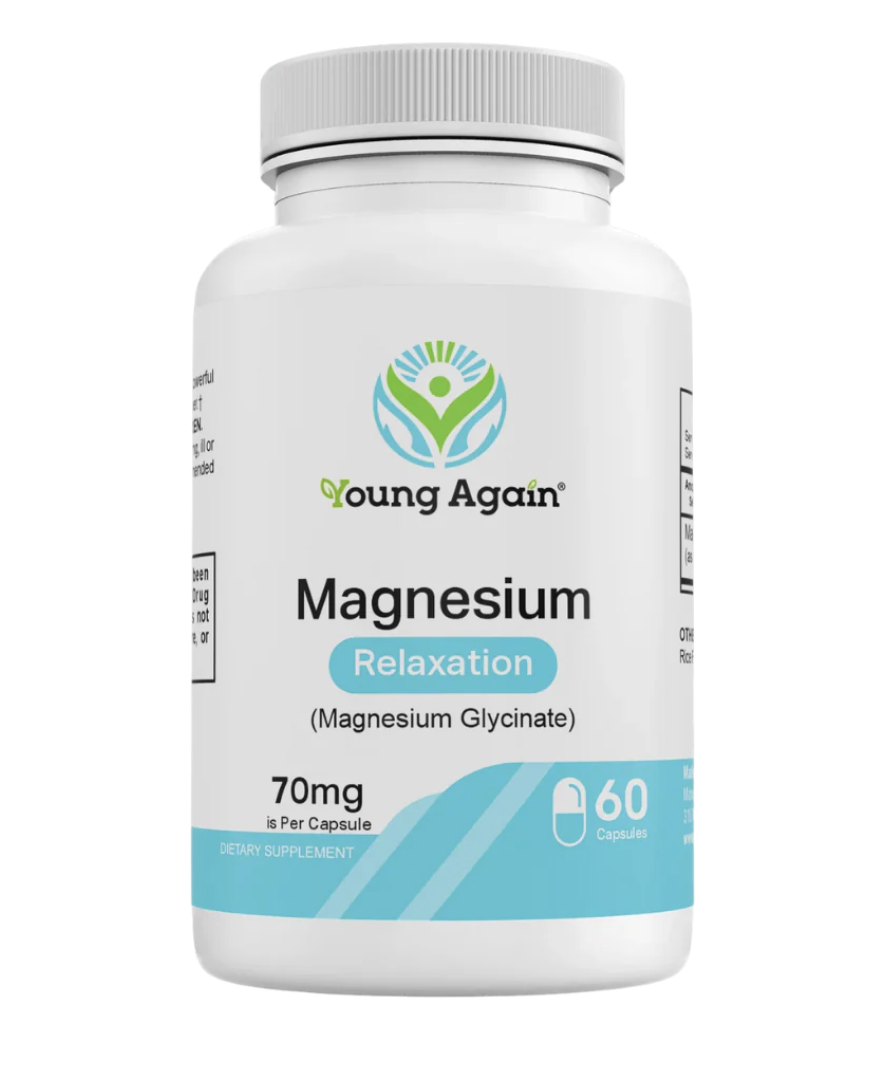
Introducing
Young Again Magnesium Glycinate
A premium, highly absorbable magnesium formula designed to support relaxation, calm your nervous system, and promote deep, restorative sleep.
- 70mg of magnesium glycinate per capsule
- Highly absorbable glycinate form
- Supports relaxation and nervous system calm
- Gentle on stomach—no digestive upset
- 60 capsules per bottle
How Magnesium Glycinate Supports Your Body
Deeper Sleep
Supports your body's ability to reach deep, restorative sleep stages
Nervous System Calm
Helps shift your body from "alert mode" to "rest mode"
Faster Sleep Onset
Supports your mind's ability to wind down and fall asleep
Morning Energy
Wake up feeling actually rested instead of groggy
Muscle Relaxation
Helps release physical tension that interferes with sleep
Stress Resilience
Supports healthy stress response during the day
Why Choose Young Again
Premium Quality
Highly Absorbable
Science-Backed
Gentle Formula
Frequently Asked Questions
Magnesium glycinate is a form of magnesium bound to glycine, an amino acid with calming properties. This combination makes it highly absorbable and particularly gentle on the digestive system—unlike some other forms of magnesium that can cause stomach upset.
Magnesium helps regulate GABA, a neurotransmitter that calms brain activity. It also helps relax muscles, supports healthy cortisol levels, and plays a role in your body's circadian rhythm. Together, these effects help your nervous system shift from "alert mode" to "rest mode."
For sleep support, most people find it helpful to take magnesium glycinate 30-60 minutes before bed. This gives your body time to absorb it and begin winding down. However, because it's gentle, it can also be taken earlier in the evening with dinner.
Some people notice a calming effect the very first night, while for others it may take 1-2 weeks of consistent use to notice significant improvements in sleep quality. If you've been deficient for a while, it can take time for your magnesium levels to rebuild.
Yes, magnesium glycinate is generally considered safe for daily use when taken as directed. It's one of the gentlest forms of magnesium available. However, if you have kidney issues or are taking medications, we recommend consulting your healthcare provider first.
Scientific References
- 1. Abbasi B, et al. "The effect of magnesium supplementation on primary insomnia in elderly: A double-blind placebo-controlled clinical trial." J Res Med Sci. 2012;17(12):1161-9.
- 2. Held K, et al. "Oral Mg(2+) supplementation reverses age-related neuroendocrine and sleep EEG changes in humans." Pharmacopsychiatry. 2002;35(4):135-43.
- 3. Boyle NB, Lawton C, Dye L. "The Effects of Magnesium Supplementation on Subjective Anxiety and Stress—A Systematic Review." Nutrients. 2017;9(5):429.
- 4. Nielsen FH, et al. "Magnesium deficiency and increased inflammation: current perspectives." J Inflamm Res. 2018;11:25-34.
Ready to Finally Wake Up Feeling Rested?
Stop accepting exhaustion as normal. Give your nervous system the support it needs to truly relax—and discover what real, restorative sleep feels like.
Learn More About MagnesiumFree shipping on all orders. Satisfaction guaranteed.